
Booking a Street Kart Tour on an Osaka Festival Weekend? Ride First, Then Plan the Rest Around How Your Companions Are Feeling
Booking a Street Kart Tour on an Osaka Festival Weekend? Ride First, Then Plan the Rest Around How Your Companions Are Feeling
You're on a bridge in Dotonbori when your companion suddenly stops. A sweet, savory smell of sauce is drifting over from the food stalls, and vendors all around are shouting in Osaka dialect: "Come on in, fresh off the grill!" Look at your companion's face right then. Are their eyes lighting up, or are the crowds already wearing them down a little?
Say you're in Osaka on a festival weekend and you plan to book a kart tour too. It's hard to decide which to do first, but this article recommends doing the kart first. After that, the day goes much better if you plan the rest around how your companions are feeling. Honestly, it does. On a first trip to Japan, not knowing what's coming next is a big source of stress in itself. So this article starts with what's normal in Japan on a festival day, then walks through the kart tour from booking to setting off. After that, we'll look at how to plan the day depending on how the people you're traveling with react.
What to Know Before a Festival Day in Osaka
Japanese festivals and street events draw huge crowds. Locals call the Shinsaibashi, Dotonbori and Namba area "Minami" (the South), as opposed to "Kita" (the North) around Umeda. If someone in Osaka says "I'm heading to Minami today," this is roughly the area they mean. It's a lively entertainment district even on an ordinary weekend. Add a festival, and people are rubbing shoulders on the sidewalks and queuing in front of the station ticket gates. Festivals in Australia are often held in big parks or by the beach, but in Japan it's common for the streets themselves to become the venue. First-timers are usually taken aback by just how packed it gets.
A few customs are worth knowing. There are very few public bins in Japanese cities, so you carry your food containers and skewers from the stalls with you until you find a designated rubbish collection point. Keeping a small plastic bag in your pocket makes a real difference. It's the same idea as "Leave No Trace" in the outdoors: in the city, you clean up after yourself as well. Do that, and you'll notice the locals warm to you.
There are queues too. At popular food stalls and photo spots, Japanese people line up quietly in single file and wait their turn. Nobody cuts in. Osaka people love to talk, but when it's time to queue, they queue properly. They're strict about that.
Festival dates, venues and road closures are announced by the organizers, so check the official information before your trip. Booking early matters just as much. Street Kart tends to book out on weekends, so if you want to ride on a festival weekend, book as soon as you know the festival dates. If I were planning a two-night, three-day weekend in Osaka, I'd book the kart tour at the same time as the flights and hotel.
From Booking to Setting Off: What Happens
Booking methods and contact details are on the Street Kart official website. Check there for the latest booking process. The site is available in 22 languages.
The first thing to check is your driver's license. The documents you need to drive in Japan depend on the country that issued your license. Check the official website to see which licenses and documents apply in your case. Whether you sort this out before you leave makes a huge difference to how relaxed you feel on the day. Check other requirements, such as age, on the official website as well.
The Osaka store is in Minami-Horie, a stylish neighborhood of vintage clothing shops, homeware stores and cafés, a little calmer than the heart of Minami. The store has no parking, so come by train. The nearest station is Nishi-Ohashi on the Osaka Metro Nagahori Tsurumi-ryokuchi Line, a 3-minute walk away. It's a 5-minute walk from Yotsubashi Station on the Yotsubashi Line. Locals often say the name "Yotsubashi" ("four bridges") comes from the canals that once crossed here, with four bridges spanning them. The canals have since been filled in and the bridges are gone, but the name lives on. Osaka is full of place names like this, left over from its days as a city of waterways. Oops, I'm getting off track. On festival days the station exits get crowded, so aim to arrive a bit early and give yourself some breathing room.
The store has a toilet and Wi-Fi. There's also a convenience store within a 5-minute walk if you need to grab more drinks.
On the day, the tour is generally guided in English. Whether guidance is available in Japanese or other languages depends on the staff that day and can't be guaranteed. If you're worried about language, ask when you book. Tour length varies by plan. The safest way to plan is to confirm the duration when booking and fit your festival plans around it.
Planning the Day Around Your Companions
Now for the main part. Same Osaka, same festival day, but how you spend it changes depending on who you're with. Let's look at three common types.
The One Who Can't Wait to Hit the Food Stalls
From the moment you leave the station, your companion's eyes are on the stalls. If that's your mate, doing the kart first is the obvious call.
The reason is simple. Beer and chuhai are part and parcel of festival stalls, and in Japan you can't drive after drinking any alcohol at all. Not even a sip. If you plan to do the stalls first and the kart afterward, the whole plan falls apart right there. And once you're full of takoyaki and yakisoba, your body feels heavy too. Osaka is famously the city of kuidaore, eating until you drop, but save the dropping for after the kart.
So ride while you've still got energy. When you're done, walk over to Minami and make the rest of the day about the stalls and the drinks. With this order, even your restless companion can stay focused on driving during the tour. And that first drink after the ride will taste all the better.
This order also suits people who don't love crowds and gradually go quiet as the day goes on. On the kart, they don't have to find their own way. The guide leads, so they just follow along behind. When you get off, look at your companion's face first. If they seem tired, stop for a break at a café in Minami-Horie before heading into the festival. Once you're there, you can also visit just one or two stalls and call it a day early, or skip crowded Dotonbori and duck into the lanes of Hozenji Yokocho instead.
Companions Who Won't or Can't Drive
Some people don't meet the license requirements, and some just aren't interested in driving. The karts are single-seaters, so nobody can ride along as a passenger. Make that clear from the start so nobody feels awkward on the day.
That said, how they spend the waiting time can completely change their day. The area around the Osaka store is ideal for killing time. Amerikamura, a 5-minute walk away, is packed with vintage and streetwear shops, and just wandering around Triangle Park gives you a feel for Osaka's youth scene. The park actually has an official name, but no local ever uses it. It's triangular, so it's Triangle Park. That's about how blunt Osaka people are with names. They could also relax at a café in Minami-Horie, or walk 15 minutes to the Shinsaibashi-suji shopping arcade and browse under its covered roof. Daimaru Shinsaibashi is also a 15-minute walk.
Decide on a meeting spot before you split up. On festival days the crowds are so thick that even if someone calls asking "Where are you?", it can be hard to explain where you are. The driver comes back from the tour, the companion comes back from exploring the streets, and swapping stories about what each of you saw turns out to be surprisingly fun.
The One Gripping the Wheel a Little Too Tight
Before you set off, your companion looks tense. If it's their first time driving abroad, that's completely natural.
What's worth telling them is that this isn't a race. The guide drives at the front and everyone follows behind. Just as your first wave in surfing is only about standing up, all they need to focus on at first is following the kart in front. No pushing, just go at your own pace.
Please don't take out your phone to film or take photos while driving. Hands on the wheel, eyes on the road. Taking photos before or after the tour, while you're on foot, is plenty.
After the ride, decide what's next based on how your companion seems. If their shoulders still look tense, don't head straight into the festival crowds. Have a breather at a café in Minami-Horie first, then set out. If they look worn out, keep your time at the festival short and head back to the hotel early. If, on the other hand, they start talking about the route the moment they get off, just walk straight on to Minami.
What Makes Street Kart Worth It
Let's pause here and talk about the karts themselves.
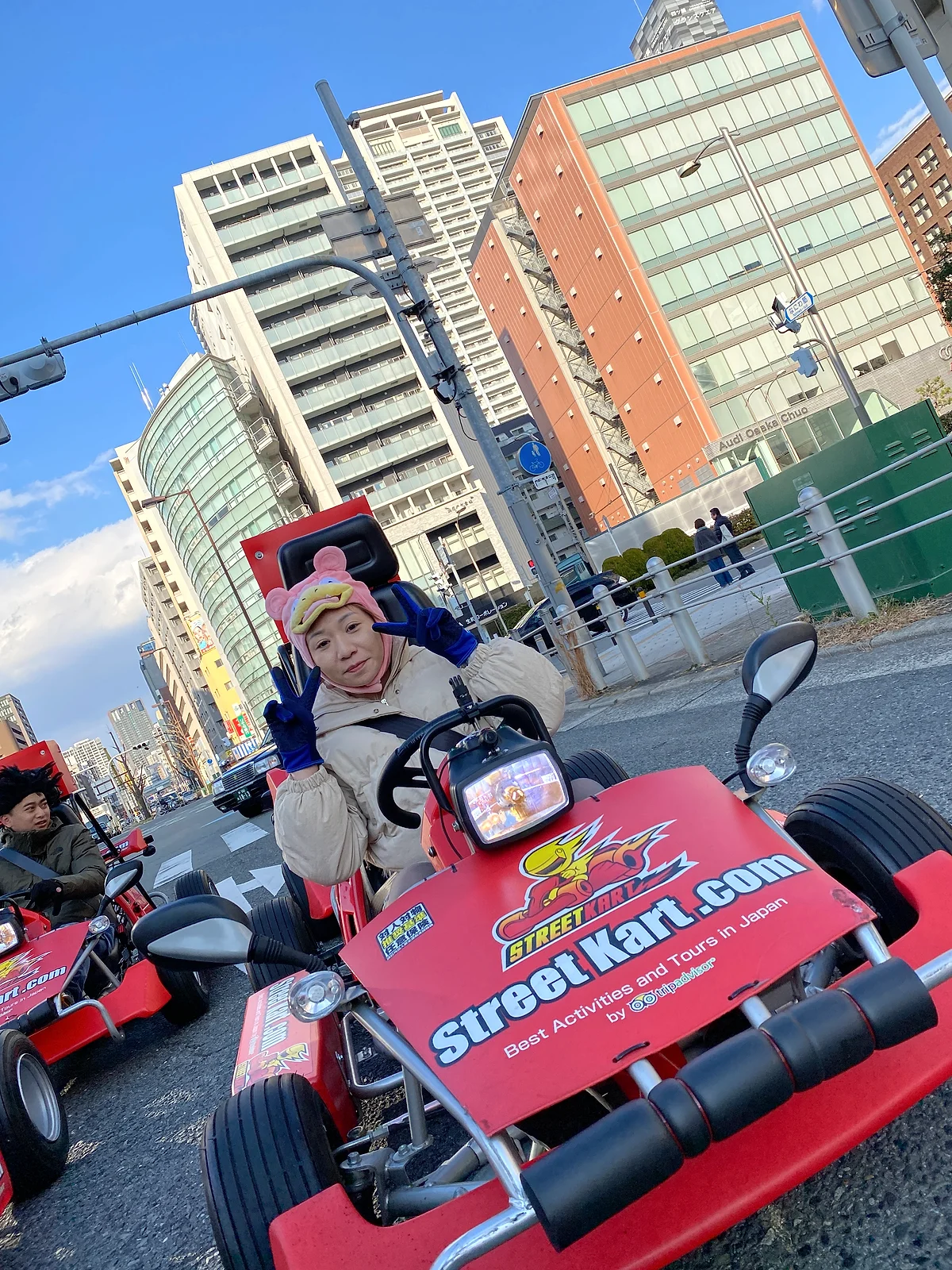
First, how it feels. Once you're driving, you feel like you're sitting much lower than usual. The signs on Minami's buildings tower above you, and the smells of the food stalls and the cheers of the crowds hit your ears and nose directly, not through a car window. It's like soaking up the festival-day buzz with your whole body.
Next, the places on the route. The Osaka store's tour starts in Minami-Horie and passes through the heart of Minami, including Amerikamura, Shinsaibashi, Dotonbori and Namba. You get to take in Dotonbori, home of the Glico sign, and Namba, Osaka's southern gateway, along with the atmosphere of the day. And one more bit of trivia: Dotonbori is said to be named after Yasui Doton, who put his own fortune into digging the canal in the early Edo period. A man's name became the name of a waterway, and now people from all over the world say "Dotonbori." Pretty neat, right? On the day, you follow the guide along the route, so you don't choose your own destinations.
After the Festival, Look Back on How Your Companions Reacted
Once you're off the kart, it's time to explore Minami on foot. In front of the Glico sign in Dotonbori is a perfect photo spot. On busy days, the etiquette is to avoid crowding the bridge railing and to leave a path clear for people behind you. One photo tip: rather than shooting the sign straight on, angle it slightly and include the reflections on the water. It captures the buzz much better. While you're at it, look out for the giant moving crab at Kani Doraku and Kuidaore Taro. This is a neighborhood where just walking around looking at the signs counts as sightseeing.
When you get hungry, have takoyaki at Kukuru in Dotonbori. Okonomiyaki at Chibo, a 10-minute walk from the store, is another good option. If you want somewhere calmer, head to Hozenji Yokocho, a 20-minute walk. Step into its narrow stone-paved lanes and the noise from a moment ago seems to vanish. Even within Minami, the atmosphere changes the moment you turn down a side lane. Know that, and you can pass for a bit of an Osaka insider.
If you have time the next morning, you could graze your way through seafood at Kuromon Market, 10 minutes by train, or head out to Osaka Castle, 20 minutes by train. Locals call Kuromon Market "Osaka's kitchen," and eating your way through it in the morning is exactly how it's meant to be enjoyed. On a two-night, three-day weekend in Osaka, keep festival day focused on Minami and save the places farther out for another day. Splitting it up that way keeps you from wearing yourself out getting around.
And at night, before heading back to the hotel, look at your companions' faces one more time. The one whose eyes lit up at the food stalls is probably talking about the kart. The one who went quiet in the crowds might be remembering the time spent following the guide. The one who didn't drive will probably show you the vintage find from Amerikamura. Same Osaka, same day, three different sets of memories. That's probably what makes traveling with friends so much fun.
Once the festival dates are set, start by asking about kart availability. Weekends tend to book out, so getting in touch early is the safe bet. You can check booking methods, license requirements and tour details on the Street Kart official website. Once the kart is booked, picture your companions' faces and plan the rest of the day around it.
This article was originally written in Japanese and translated using AI. Some expressions may read unnaturally, and we appreciate your understanding. For the most accurate and up-to-date information, please refer to the official site at kart.st.
Street Kart is not affiliated with Nintendo or the Mario Kart series in any way. We do not provide costumes of Nintendo characters, and such costumes may not be worn during tours even if brought by participants.