
First Time in Japan? Payment Pitfalls to Know Before Your Street Kart Ride in Osaka, and How to Prepare for the Day
First Time in Japan? Payment Pitfalls to Know Before Your Street Kart Ride in Osaka, and How to Prepare for the Day
You've got one credit card in your wallet and a payment app on your phone. "That should get me through Japan," you think. Then you arrive in Osaka, head into a place for lunch, and find a sign on the door: "Cash Only." Walking around Minami, I sometimes see travelers frozen in exactly that moment. For first-time visitors to Japan, it happens all the time.
This article uses a day of Street Kart driving in Minami-Horie, Osaka, as an example and goes through the moments when payments tend to trip people up and how to avoid them. It covers booking, walking around the city on the day, what to do when plans change, and what to prepare before you leave. Sort out these four things ahead of time and on the day you can focus on driving.
Three Places Where Payments Go Wrong, and How to Avoid Them
Payment trouble usually shows up in one of three places: booking and paying for the kart tour, shopping and eating around Osaka, and cancellations or schedule changes. Let's go through them one at a time.
A common mistake is building your budget around a price you saw on social media or in an old blog post. That's one to avoid. Prices vary by season and time of day, so please check the latest prices on the official website (kart.st). The number in a screenshot from a few months ago isn't necessarily today's price. Relying on it is like seeing an old photo of a restaurant and assuming it still charges what it did back then.
There's another point people new to Japanese services tend to miss. Bookings are accepted via Facebook, LINE, and email, and the contact details are listed on the official website. Check the official website for how to book, how to pay, and when payment is due, and ask about anything unclear while you're arranging the booking. Payment must be made in advance, so don't assume you can just pay at the counter on the day. Knowing that is the best way to avoid trouble.
Take screenshots of your booking messages so you can view them offline. Even if your connection gets spotty after you leave the hotel, you can show staff your booking date, time, and name right away. It's the same reason you download a map before heading into the mountains: make sure you'll be fine without a signal. That alone takes one worry off your mind on the day.
In some countries, tapping your card to pay for a single cup of coffee is completely normal. Japan, and especially Osaka's more old-fashioned neighborhoods, works a little differently. Large shopping complexes and department stores usually take cards, but small restaurants and market stalls may only accept cash. It really depends on the shop, so the safe bet is to be ready for either.
Around Minami-Horie, where the Osaka store is located, there are convenience stores like 7-Eleven, FamilyMart, and Lawson within a 5-minute walk. There are convenience store ATMs near the store, bank ATMs around the major stations, and currency exchange at the airport and major stations.
One thing to watch out for: rushing to an ATM right before your tour. It's a good idea to check in advance which ATMs accept your foreign-issued card. Some card companies recommend letting them know ahead of time that you'll be using your card abroad, so check that too, just in case. Once you land in Japan, get a little cash at the airport or at a station near your accommodation. Then head to Minami-Horie with both your card and cash. Do it in that order and you won't be rushed.
While we're at it, here's one more Japanese payment custom. Tipping isn't customary in Japan. Also, at the register, instead of handing money directly to the staff, people usually place it on a small tray on the counter. In the trade, this tray is called a "carton" (karuton). Surprisingly few Japanese people know the name, so it makes a nice bit of trivia. It might feel awkward at first, but watch the person in front of you once and you'll get used to it quickly.
Travel plans fall apart. Flights get delayed, or you walk so much around Dotonbori the day before that your legs are killing you. At times like that, knowing the cancellation policy takes a lot of the stress away.
Street Kart cancellations are free up to 7 days in advance. Check how later cancellations and date changes are handled when you book. If your itinerary isn't settled yet, put that "7 days before" deadline in your planner or phone calendar so you don't miss the moment to decide.
When you book matters too. Weekends fill up quickly, so if you want to ride on a Saturday or Sunday, book early. Putting it off with "I'll figure it out once I get to Osaka" and then not getting the day you wanted is another common first-trip mistake.
Getting Ready for the Day in Osaka Before You Set Out
Once your payments are sorted, think about how the day itself will go. The same approach you'd use for an outdoor trip works here: decide on weather, transportation, and what to bring in advance, and you'll have far fewer moments of panic on the ground.
Getting to Minami-Horie by Train and on Foot
First, transportation. The Osaka store has no parking, so please use public transportation. The store is a 3-minute walk from Nishi-Ohashi Station on the Osaka Metro Nagahori Tsurumi-ryokuchi Line and a 5-minute walk from Yotsubashi Station on the Osaka Metro Yotsubashi Line. From Shinsaibashi Station it's a 12-minute walk, and from Namba Station, 15 minutes. In an unfamiliar city, transfers take longer than you'd expect, so leave your hotel with time to spare.
A quick detour: the name "Yotsubashi" ("four bridges") is said to come from the canals that once crossed here, with four bridges spanning them. The canals have since been filled in and there's little trace of them left, but place names here, including "Horie" ("canal inlet"), still carry memories of the days when this was a city of water. When you step out of the station, try walking with the thought that a river once flowed here.
On your way from the station, it's worth checking where those convenience stores I mentioned are. You can withdraw cash, buy a drink, or take a short break. Knowing where you can stop if you need to is like checking where the water sources are at the trailhead.
Check Your Driver's License and What to Bring on the Official Page
Next, your driver's license. This is not something to judge for yourself. Whether you can drive on Japanese roads with your home license depends on the country that issued it and the documents you have. Check what type of license you need and what to bring on the day on the official website's driver's license page. Please refer to the official website for details. The saddest way the day can go wrong is finding out on the spot that your documents aren't enough to drive. Get this checked before you leave for Japan.
We recommend traveling light: wallet, card, phone, and your license documents. The more important an item is, the more you need to know exactly where you put it. Ask at booking whether you can leave luggage and how it's handled, and the day will go more smoothly.
Use Your Phone "Before" and "After" the Drive
If you'll be using payment or translation apps, finish setting them up and logging in before you leave. Wi-Fi is available inside the store, and there's free Wi-Fi at nearby cafés and shopping centers. Still, the trick is not to rely entirely on a connection. Make sure two things are viewable offline: a screenshot of your booking and a map from the station to the store.
And one important thing: don't touch your phone while driving. Even locals get the urge to photograph the Dotonbori signs. But while you're driving, your attention belongs on the road ahead and the guide leading the way. Take photos before and after the drive. Just as you respect nature when you're out in it, you drive with respect for the city and the people around you. That's what lets everyone enjoy the experience.
Don't Make the Weather Call Yourself
It's natural to feel uneasy when rain looks likely. Raincoats are provided, but follow the official guidance on whether the tour goes ahead in bad weather and how it's handled on the day. Whether you're at sea, in the mountains, or in the city, the judgment of people who know the place is more reliable than your own "it'll probably be fine." If you're worried, contact them ahead of time through the same channel you used to book, and you can go into the day calm.
Know the Language of the Tour
Tours are generally guided in English. Whether guidance is available in Japanese or other languages depends on the staff that day and can't be guaranteed. If you're not confident in English, prepare in your own way, for example by asking in advance about hand signals or setting up a translation app before you leave. If you have concerns about language, contact the store through the details on the official website beforehand. The official website is available in 22 languages.
Why People Choose Street Kart
Here's a quick summary of what the Street Kart experience is like.
First, trained guides lead the way. Every tour has a guide who manages the route and keeps an eye on safety. For anyone driving on Japanese roads for the first time, I think having a guide up front is reassuring.
Second, you drive a set course. Each store's tours follow a fixed route, so you can't go wherever you like. While driving, keep your wallet securely put away.
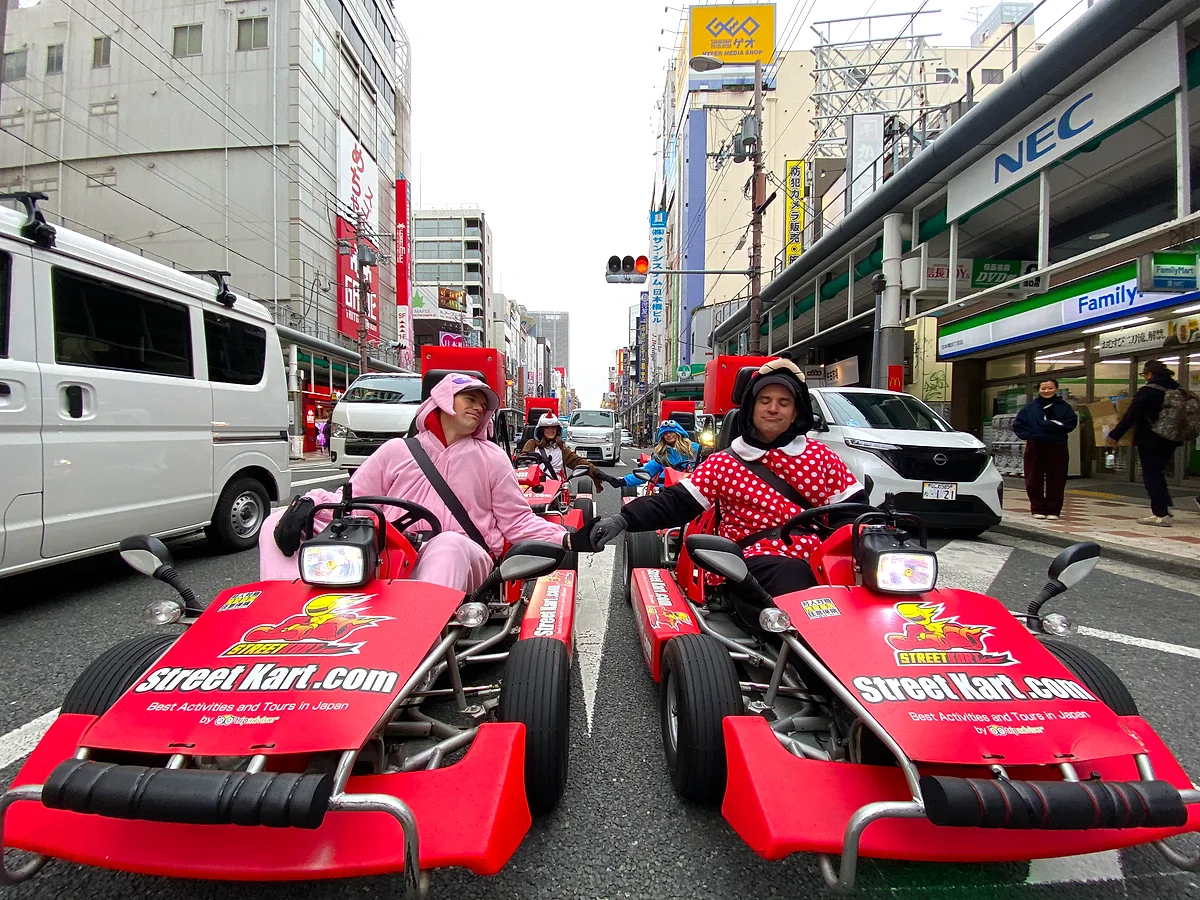
Third, the course takes you through the streets of Osaka's Minami district. The Osaka store's tour passes through Amerikamura, lined with vintage clothing and streetwear shops; Shinsaibashi, Osaka's signature shopping district; Dotonbori, with its rows of neon; and Namba, the gateway to southern Osaka. The sheer size of the signs when you look up from a low, open-top seat, the sounds of the city right beside you, the wind on your hands as you grip the wheel. Even on streets locals walk every day, seeing them from a different eye level makes a familiar city look a little different.
Fourth, there are stores across Japan. Street Kart operates 9 stores nationwide (7 in Tokyo, 1 in Osaka, 1 in Okinawa). If you enjoy it in Osaka, you can ride again at another stop on your trip.
Fifth, the track record. As of November 2023, across all stores, Street Kart has run more than 150,000 tours, served more than 1.34 million customers, and received more than 20,000 reviews, with an average rating of 4.9 out of 5.0.
Finally, the support from research before booking through to guidance on the day. The official website is available in 22 languages, tours are generally guided in English, and bookings are accepted via Facebook, LINE, and email.
Osaka After the Drive, and Final Prep Before Booking
When the tour is over, it's time to step out of the kart and explore Osaka on foot. From the Minami-Horie store, Amerikamura is a 5-minute walk, Shinsaibashi 15 minutes, and Dotonbori 20 minutes. You can take your time walking the streets you just drove through. Locals shorten Amerikamura to "Ame-mura," so use that when asking for directions and people will know what you mean. If you want to go a little farther, Kuromon Market is about 10 minutes away by train. It's known for fresh seafood and street food and is nicknamed "Osaka's Kitchen."
This is where the cash advice from the beginning pays off. Market stalls and small restaurants may only take cash, so having a little on hand opens up more options. When you're done eating, return your containers and trash to the shop you bought from or take them with you. Whether at the beach or in the city, leave the place cleaner than you found it. It makes the trip feel a little better too.
Finally, here's what to do before booking. Check the latest prices on the official website. Look up how to book on the official website, make your booking, and ask about payment methods and timing while you're arranging it. Check the driver's license requirements on the official page. Put the 7-day cancellation deadline in your calendar. When you arrive in Japan, get a little cash at the airport or a station.
With all that done, on the morning of your tour you just grab your card, cash, and documents and take the train to Minami-Horie. Get off at Yotsubashi and walk to the store along streets that were once canals. Weekends fill up quickly, so once you've decided on a date, get in touch early. Do the prep, and on the day you can focus on driving through Minami.
This article was originally written in Japanese and translated using AI. Some expressions may read unnaturally, and we appreciate your understanding. For the most accurate and up-to-date information, please refer to the official site at kart.st.
Street Kart is not affiliated with Nintendo or the Mario Kart series in any way. We do not provide costumes of Nintendo characters, and such costumes may not be worn during tours even if brought by participants.