
Where to Go After Your Kart Ride in Minami-Horie, Osaka: Using the Changing Scenery Along the Route as Your Guide
Where to Go After Your Kart Ride in Minami-Horie, Osaka: Using the Changing Scenery Along the Route as Your Guide
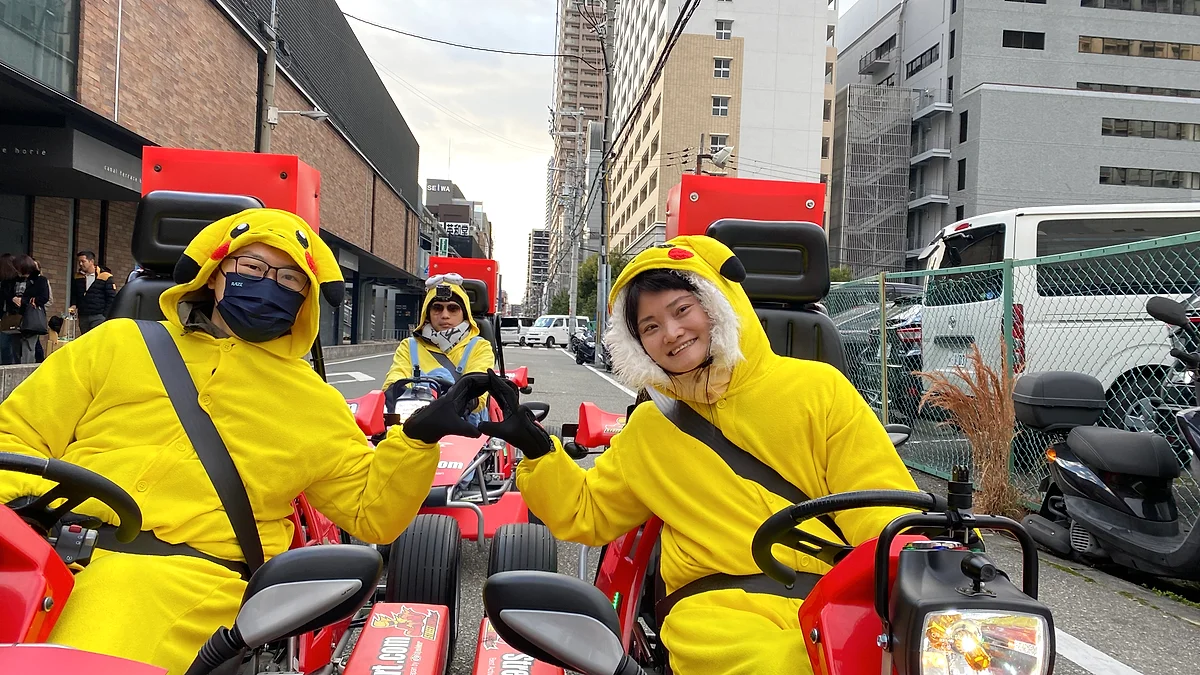
The light turns green. The guide's kart in front pulls away smoothly, and you press the accelerator. From the low seat you look up at Osaka as the city slides past behind you. You leave a quiet street of cafés and come out onto a block lined with vintage clothing shop signs. Before long you can see the entrance to a covered shopping arcade, then neon along the river.
When a street kart tour ends, most people have the same thought: "Can I walk to that street we just passed?"
If you don't know Osaka well, the time after the tour can be harder to plan than you'd expect. You don't have a map of the area in your head yet, and you don't know what's within walking distance or where you'll need a train. This article walks you through a way to pick your next stop in Osaka after the ride, step by step, using how the scenery changed along the route as your guide.
What happens after you get out of the kart, and what you might be unsure about
First, some background. On a Street Kart tour, each participant drives their own single-seat kart behind a guide along a set route. When I rode, I didn't have to think about where to turn, so I had attention to spare for the scenery. You can't just drive wherever you like. If you spot a shop you like along the way, resist the urge and file it in your head as "somewhere to walk to later." That's where the approach in this article starts.
I recommend copying those mental notes into your phone as soon as you're out of the kart and have settled down. A rough phrase like "vintage shop with the blue sign" or "huge sign by the river" is enough. As time passes, you lose track of which sights came in which order. If you list them in the order you passed them, it's much easier to place them later when you check a map app: "Oh, so that shop was on this street."
The Osaka shop is in Minami-Horie. That's on the southern side of central Osaka, near the western edge of the nightlife and shopping district called "Minami." After the tour you can choose between places within walking distance and places one to a few subway stops away.
Tour length depends on the plan, so check the official website for details. If you don't know when the tour will finish, it's hard to plan what comes after. So instead of a tight schedule, keep a few options in mind and choose on the spot, based on your mood and how light it still is.
A quick word about how your body may feel after the ride. The kart seat is low, and you take in the wind and street noise with your whole body. When I rode, I only noticed after I got out how tense my shoulders had been. It's easier to stop somewhere and catch your breath first than to go straight into a crowd. Look up your next destination on a map app after you've gotten out and settled down. Don't touch your phone while you're driving.
How the scenery changes along the route
Now for the main part. The scenery on the drive out from Minami-Horie changes in clear stages, a kind of gradient. It goes from quiet streets, to streets with more and more color and sound, to an area where the lights and crowds suddenly get much denser. If you remember how that felt from the kart, your choice of where to go next narrows down naturally.
The route follows a course set by the shop. The Osaka shop's tour (Tour S) runs from Amerikamura to Shinsaibashi to Dotonbori to Namba. Check the official website (kart.st) for course details.
Minami-Horie and Yotsubashi: the feel of quiet streets from a low seat
Minami-Horie, where the shop is, is an area full of small shops and cafés. If you know Tokyo, it has a feel similar to Daikanyama or Ura-Harajuku. Step one street back from the main road and the traffic noise fades a little. You can see shop lighting and plants through the glass. From the low seat of a kart, you can clearly see the signs out front and even the tiles on the ground. Things you never noticed while walking suddenly catch your eye, and that's surprisingly fun.
Neighboring Yotsubashi is also about a 5-minute walk away. It's a shopping area with a scattering of shops popular with younger people. If you've just finished the ride and still feel a bit lightheaded, a café in this quiet area is a good fit. Drink a coffee at your own pace while you think back on the feel of the wind.
Osaka cafés such as Arabica and the Starbucks Shinsaibashi store are worth adding to your list. Wherever you go, sit by the window if a seat is free. You'll be looking at the street you just drove down, this time from normal eye level. It's the same street, but the signs seem to sit in slightly different places and the potted plants out front look a different size. Comparing the low view with your usual one is another way to enjoy the stop.
Amerikamura: where color and sound suddenly increase
Head a little east from Minami-Horie and the atmosphere changes completely. Amerikamura, which locals call "Ame-mura," is a 5-minute walk from the shop. It's lined with vintage clothing and streetwear shops and is the center of Osaka's street culture. There's graffiti on the walls, T-shirts hanging in front of shops, and music coming out of one shop or another. If you noticed from the kart that things suddenly got more colorful, you were probably around here.
In the middle of Ame-mura is a small plaza called Triangle Park (Sankaku Koen), a common landmark for meeting up or taking a break. If it's your first time, remember "if you get lost, head for Triangle Park" and you'll find it easier to get around. Each vintage shop is small, so it's fun to zigzag through the streets and stop in wherever catches your interest. You go looking on foot for the signs you saw during the drive. It's a bit like a treasure hunt.
There's also a trick to the order of your shopping. You can't bring much luggage in the kart, and a small bag is recommended if you bring one. Rather than showing up at the shop already carrying several pieces of vintage clothing, it makes more sense to finish the ride, travel light, and then pick up your shopping bags in Ame-mura.
If you eat as you walk, use the trash bin near the shop where you bought the food, or take your trash with you. Keeping a small plastic bag in your bag makes this much easier. Some small shops only take cash, so it's a good idea to carry a little cash too.
Shinsaibashi, Dotonbori, and Namba: the lights and crowds get denser
Go further east and you enter Osaka's best-known shopping and nightlife district. Shinsaibashi is a 15-minute walk from the shop. The Shinsaibashi-suji Shopping Street is a covered arcade, which is handy because you can walk it without getting wet on a rainy day. Small independent shops sit next to big chain stores, and the scenery keeps changing even over a short walk. Department stores such as Daimaru Shinsaibashi (a 15-minute walk) are also on this stretch.
South of there, about a 20-minute walk away, is Dotonbori. Huge signs line the river, and the Glico sign, the Kani Doraku crab sign, and Kuidaore Taro are classic photo spots. The Dotonbori River Walk runs right beside the water, so you can see the lights of the signs rippling on the surface up close. Further south is Namba, the district often called Osaka's southern gateway. It's home to Yoshimoto's Namba Grand Kagetsu and to Namba Parks (a 20-minute walk). Having the mecca of Japanese comedy on the same stretch is very typical of Minami. If you've walked all the way to Namba, it's also worth looking around an electronics store like Bic Camera Namba.
The problem in this area is that there's too much you want to eat. For takoyaki and okonomiyaki there's Chibo, Kukuru, and Mizuno. For kushikatsu (deep-fried skewers) there's Daruma and Yaekatsu. For ramen there's Kinryu Ramen and Ichiran Dotonbori. If you walk around distracted by the lights, you stop knowing what you even want to eat. So before you head into the district, decide on just one dish: "takoyaki today" or "kushikatsu today." That alone makes your route clear. If you'd like a meal with a different feel from the neon streets, Hozenji Yokocho, an alley with kappo and other traditional Japanese restaurants, is another option.
This area is where the feeling of things getting livelier and livelier, which you had in the kart, reaches its end point. If you still have energy left, it's well worth walking this far.
Three steps for choosing your next stop based on the scenery you want to see again
Once you understand how the scenery changes, all that's left is to choose. Here I'll split the process from the end of the tour to picking a destination into three steps.
The first step is to recall how intense the scenery that stuck with you most was. Did you enjoy the quiet streets? Did the moment color and sound picked up excite you? Or were you blown away by the neon and the crowds? If you liked the quiet of Minami-Horie and Yotsubashi, keep things within a 5-minute walk. If the cluttered feel of Ame-mura drew you in, walk toward Triangle Park. If you want to take in the dense lights and crowds, go from Shinsaibashi to Dotonbori. This way you can decide by three levels, quiet, lively, and very lively, even if you don't know the place names yet.
The second step is to be honest about how your body feels. Your arms from gripping the wheel and your legs from bracing in the low seat will be somewhat tired. If you feel worn out, head to a nearby café where you can sit down. If you still have energy, take the 20-minute walk to Dotonbori. The trick is not to push yourself and to pick a distance that suits how you feel that day. If walking is too much, you can also take the subway from Yotsubashi or Nishi-Ohashi Station.
On the other hand, if you still have plenty of energy and want to see a different side of Osaka from what you saw from the kart, you can go further by train. Kuromon Market is about 10 minutes away by train, a market where you can snack on fresh seafood as you walk around. Tsutenkaku Tower and Shinsekai are about 15 minutes by train. You can go up to the observation deck at Tsutenkaku, try a kushikatsu shop, or visit Billiken, the local good-luck figure. Osaka Castle is about 20 minutes by train, with its main keep and Osaka Castle Park. These places aren't on the tour route, though. Think of them as "another Osaka" rather than "a continuation of the route you drove," and save them for days when you have time and energy to spare.
The third step is to check how light it is and the season, and use that to make your final choice. Even in Dotonbori, while it's still light you can see the colors and shapes of the signs clearly and enjoy the look of the city itself. After dark, the lit-up signs take center stage, and with their reflections on the river the place looks like a different city. The weather also affects the final choice. If you finished the ride in the rain, narrow it down to one of two options so you don't waste time deciding: head to the covered Shinsaibashi-suji arcade, where you can walk without getting wet, or warm up in a nearby café before moving on.
If you feel like going somewhere high after dark, Abeno Harukas, about 15 minutes away by train, is another option. It's a 300-meter-tall building with the Harukas 300 observation deck. After looking up at the city from a seat close to the ground, you look down on it from the sky. It's a bit of a treat: you get both extremes of eye level in a single day.
What to check before you book
Finally, here are the points to check before you book.
The most important is your driver's license. You need a valid driver's license to take part, and the requirements depend on your country and license type. To avoid finding out on the day that your license doesn't qualify, be sure to check the official website before you go.
Check the guidance language too. On the day of the tour, guidance is given mainly in English. Guidance in Japanese or other languages depends on the staff working that day and isn't guaranteed. If you'd like guidance in a language other than English, ask in advance. The website supports 22 languages, but that applies to the site only, not to the guidance on the day.
It also helps to think about your luggage and footwear before your post-tour outing. The shop has lockers for small items, but they aren't suited to large luggage like suitcases. There's also no parking at the shop, so you'll need to get there by train or subway. If you're coming to the tour after checking out of your hotel, leave your large luggage at the hotel or in a coin locker at the station first. That way you can travel light after the ride too. As for clothing, the basics are closed-toe shoes (sneakers are recommended) and clothes that are easy to move in. You're asked to avoid heels and open-toed shoes. If you plan to walk as far as Dotonbori afterward, it's all the more important to wear shoes you're used to walking in.
Check the weather as well. In light to moderate rain the tour goes ahead as scheduled, and raincoats are provided free of charge. Tours are canceled in heavy rain or typhoons. Check the official website (kart.st) in advance for how cancellations are handled.
Prices vary by season and time of day, so check the official website (kart.st) for details.
Bookings are accepted via Facebook, LINE, or email (booking@streetkart.com). Weekends tend to fill up, so if you want to ride on a weekend, book early. Once your travel dates are set, reserve your tour slot first. Then, with the steps in this article in mind, jot down about three options for after the ride: a café in quiet Minami-Horie, Triangle Park in Ame-mura, and the riverside in Dotonbori. With those three levels in hand, you can choose on the spot without hesitation, based on how you feel that day and how light it is.
The Osaka you look up at from a kart's low seat and the Osaka you walk on your own feet are the same city, but they look very different. Since you've come all the way to Minami, try putting the two side by side in a single day. Kuidaore Taro will probably be waiting for you.
This article was originally written in Japanese and translated using AI. Some expressions may read unnaturally, and we appreciate your understanding. For the most accurate and up-to-date information, please refer to the official site at kart.st.
Street Kart is not affiliated with Nintendo or the Mario Kart series in any way. We do not provide costumes of Nintendo characters, and such costumes may not be worn during tours even if brought by participants.